Friday, December 4, 2009


Replication in ClimateGate

Irritatingly often I see comments on Climategate blog posts saying that economics and climatology aren't real sciences. I don't mind Econ not being classified as a science; rather, it is the scoffing tone that I don't like. Econ is not a science; it's better than science. But I won't argue that here.

Rather, the main issues in ClimateGate are not special to science. Peer review and intimidation of editors and other scholars is not. Close linkages with supposedly unbiased blogs and newspapers is not. Violating freedom-of-information laws is not. Sloppy scholarship is not. And, finally, the refusal to allow replication is not.

By that I don't mean to say that all these sins are common in every field. Far from it! But they are possible in every field.

Consider replication. The issue in ClimateGate is the temperature data series. The scientists started with raw data from hundreds of weather stations covering 150 years, and their end product is a monthly average temperature for every sector of the globe (and a global average too). They did not measure the temperatures themselves-- they used data thousands of other people collected over 150 years, 95% of which is publicly available, much of it on the web. Their task was to process the data. They had to choose which weather stations are reliable and average different weather stations within a sector, for example. If one station only existed from 1850 to 1917 and the next one in the vicinity lasted from 1935 to 2009, they had to figure out what to do. They had to worry about the Urban Heat Island effect--- what happens when a city full of hot air and concrete grows around a weather station that started out in an empty field. So there was a lot of processing.

What East Anglia would not reveal is which weather stations it used for what years, and how exactly they made the adjustments to get their sector averages. Thus, nobody can replicate their work. Indeed, they can't do it themselves--- they have admitted that they destroyed much of their input data, and the ClimateGate leak tells us that even if they had it, their computer code is too poorly written for anybody to understand, even themselves. Now, back to the general case. This is not a failure of the scientific method, especially. It could happen in any field with sufficiently low standards for publication, if any other such field existed. Analogies:

  1. A mathematician claims to have squared the circle. He gives us the axioms and the proposition, but keeps the proof secret. "I need to use some of the techniques for future research," he says.

  2. An economist claims to show that sales of Twinkies are a good predictor of recessions. He shows us a graph, and the results of many regressions that have high R2 and significant coefficients, but he keeps the Twinkies sales data secret. "The company that gave it to me did so on condition that I not reveal their sales to competitors," he explains.

  3. An English professor claims that contrary to what Mencken claims in his famous essay, the American South has produced more good literature than any similarly sized region in the world. He says there are 127 great novels from the South, but he doesn't say what they are or why they are great, or what other regions have produced. "This is the consensus of the people in my field, though I won't say exactly who because that is too personal, and the people in my field are very smart and have studied books a lot more than amateurs," he says.

Labels: ,


To view the post on a separate page, click: at (the permalink).

Friday, November 27, 2009


ClimateGate, New Zealand Fakery

I'm really enjoying this. It's the best things since Dan Rather's faking of the George Bush letter. I'll use this post to list some of the best articles.
  • The Climate Audit denier blog has had lots of good stuff.
  • Iowahawk Geographic: The Secret Life of Climate Researchers "The Alpha Grantwriter in our hive has been very successful indeed. He has earned three publications, a keynote address, and attracts the attention of a suitor from the symbiotic grant-giving predator genus Lucra Ecologica Hysterica. The suitor's grant bags are bulging with carbon credits and tax revenues harvested using the hive's last graphs, and the pair once again engage in their annual cross-pollination ritual"

  • REGIONAL TEMPERATURE CHANGE Vincent R. Gray. "The high Russia/Soviet figures indicate a common trend of large temperature rises in remote rural sites in severe climates. Other examples are Canada minus W Yukon (+0.96°C), North Pacific (+0.90°C) Spitzbergen (+4.06°C) and South Georgia (+1.91°C). The main reason would surely be the pressure to improve living conditions in these remote sites, involving better heating in the buildings, provision of roads, and the tendency for vegetation around the sites to be encouraged. The narrowing of the diurnal temperature range for many of these sites (Easterling et al. 1997) is further evidence for this tendency. "
"Courtillot and his colleagues were forced to turn to other sources of temperature measurements. They found 44 European weather stations that had long series of daily minimum temperatures that covered most of the 20th century, with few or no gaps. They removed annual seasonal trends for each series with a three-year running average of daily minimum temperatures. Finally they averaged all the European series for each day of the 20th century."

Labels: ,


To view the post on a separate page, click: at (the permalink).

Monday, November 23, 2009


The Climate Change Email Leak

From an op-ed at the London Times:

Moreover, the scientific basis for global warming projections is now under scrutiny as never before. The principal source of these projections is produced by a small group of scientists at the Climatic Research Unit (CRU), affiliated to the University of East Anglia.

Last week an apparent hacker obtained access to their computers and published in the blogosphere part of their internal e-mail traffic. ...

Astonishingly, what appears, at least at first blush, to have emerged is that (a) the scientists have been manipulating the raw temperature figures to show a relentlessly rising global warming trend; (b) they have consistently refused outsiders access to the raw data; (c) the scientists have been trying to avoid freedom of information requests; and (d) they have been discussing ways to prevent papers by dissenting scientists being published in learned journals.

There may be a perfectly innocent explanation. But what is clear is that the integrity of the scientific evidence on which not merely the British Government, but other countries, too, through the Intergovernmental Panel on Climate Change, claim to base far-reaching and hugely expensive policy decisions, has been called into question.

From the New York Times, which as I recall published the top-secret Pentagon Papers:

The documents appear to have been acquired illegally and contain all manner of private information and statements that were never intended for the public eye, so they won’t be posted here.
Below is a comment I posted on Marginal Revolution:

My reaction is like that of physicist David Wright: it is appalling that the scientists in the emails are concealing data and trying to suppress their rivals' research. I haven't heard of that in economics. (I am not surprised at this in climate science, but I would be in almost any other area of science.) Indeed, there are a number of episodes in which mistakes have been found in famous economics papers because of close scrutiny of data voluntarily supplied by the writers to scholars they know will search for every flaw. Examples are the Feldstein social security programming error, Lott's work on gun control, and Levitt and Donohue on abortion and crime.

Of course, all work has some mistakes, and a sophist could use trivial mistakes to try to discredit a paper, but in the profession trivial mistakes are expected and do not discredit, and we are all aware that big mistakes are very possible too, even from top researchers. Moreover, the custom of revealing one's data and methods is a deterrent to deliberate fraud. I haven't heard of deliberate fraud in econ published papers, but if climate science does not have the custom of making data and methods publicly available, we should predict that fraud will occur.

Labels: , ,


To view the post on a separate page, click: at (the permalink).

Tuesday, November 17, 2009


Leibniz versus Newton on God's Intervention in Nature (and Leibniz on Locke too)

Professor O'Connor pointed me to two interesting passages from the famous correspondence of Leibniz with Samuel Clarke, a philosopher and follower of Newton. See http://www.archive.org/stream/philosophicalwri029664mbp/philosophicalwri029664mbp_djvu.txt, number 192-193.

IT appears that even natural religion is growing very much weaker. Many hold that souls are corporeal ; others hold that God Himself is corporeal. Mr. Locke and his followers are at any rate doubtful whether souls are not material and naturally perishable....

Mr. Newton and his followers have also an extremely odd opinion of the work of God. According to them God has to wind up His watch from time to time. Otherwise it would cease to go. He lacked sufficient fore- sight to make it a perpetual motion. This machine of God's is even, on their view, so imperfect that He is obliged from time to time to come to its assistance especially out of the ordinary course, and clean it, and even to mend it, as a clock- maker might his handiwork; and the less skilful the workman is, the more often is he obliged to rehandle and correct his work. According to my view, the same force and vigour goes on existing in the world always, and simply passes from one matter to another, according to the laws of nature and to the beautiful pre-established order. And I hold that, when God performs miracles, it is not to uphold the needs of nature, but for those of grace. To think otherwise would be to have a very low opinion of the wisdom and power of God.

The web source says:

Clarke thinks that the passage to which Leibniz is referring is the following, from Newton's Optics: ' Whilst the comets move in orbs very eccentrical, with all variety of directions towards every part of the heavens; 'tis not possible it should have been caused by blind fate, that the planets all move with one similar direction in concentrick orbs; excepting only some very small irregularities, which may have arisen from the mutual actions of the planets and comets upon one another; and which 'tis probably will in length of time increase more and more, till the present system of nature shall want to be anew put in order by its Author.' (The translation from Newton's Latin is Clarke's.)

Labels: , ,


To view the post on a separate page, click: at (the permalink).

Thursday, October 8, 2009


The Meadow Mushroom, Agaricus Campestris

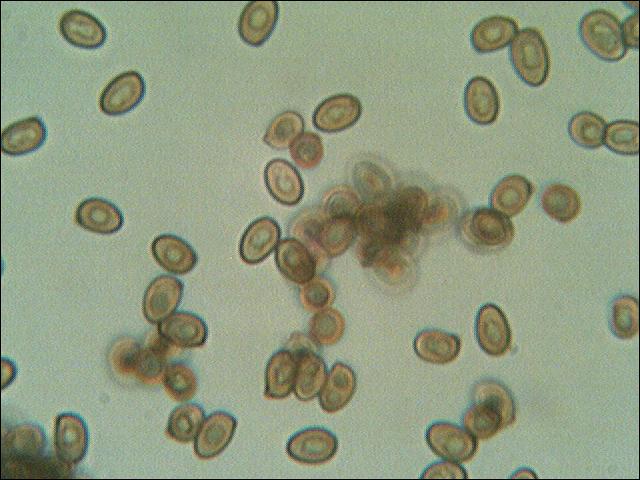
Lillie and Faith and Benjamin and I went jogging (Ben on his bicycle) and brought home a white lawn mushroom with red-black gills. It seems to be an Agaricus Campestris, prettily named, a Meadow Mushroom. It had a brown spore print, free gills, and soaked up water readily. We looked at the spores under the microscope, and they did look like the spores above, though I don't remember seeing the green interiors under our smaller 900x magnification. That photo is from an amateur's good webpage at http://www.mushroom-collecting.com/mushroomhorse.html.

We had a coprinus for breakfast this morning--- two actually, probably shaggy manes, though I didn't check. Amelia and Mom collected them from near the church. They didn't liquefy overnight.

Labels: ,


To view the post on a separate page, click: at (the permalink).

Monday, June 29, 2009


Presidents Bush and Obama and Science

Jonathan Adler at VC has a good post with links on the "War on Science" idea that the Bush Administration was hostile to science and that Obama would be friendly to it. The exact opposite is true, of course.

Two weeks ago, Roger Pielke Jr. marshaled evidence that a government contractor with substantial industry ties may have been responsible for misrepresenting the relevant peer-reviewed scientific literature in an important government report on climate change. This past week, the EPA was accused of suppressing an agency's employee's comments on the EPA's proposed greenhouse gas "endangerment finding" (the official finding that greenhouse gas emissions may threaten public health and welfare). Here again, Pielke finds the parallel with the Bush Administration's conduct instructive.

From an earlier Adler post, reformatted by me: :

One of the best examples of the politicization of science by the "left" — and one of the few that Mooney acknowledges — is the treatment of agricultural biotechnology, and the decision to subject such products to more stringent regulatory review than those developed with other methods. This policy has no scientific basis, as the National Academy of Sciences has stated many times.

Another example would be claims by environmentalist groups that pesticide residues on foods pose a significant cancer risk, a claim which the NAS has also rejected.

A third would be seeking endangered species listings for the purpose of halting development.

A fourth would be efforts to claim asthma incidence (as opposed to asthma attacks) are related to outdoor air pollution, when there is no data to support such a claim.

A fifth would be the EPA's second-hand smoke study, which a federal court found was driven to reach a predetermined result.

A sixth would be claims that the "precautionary principle" is a "science-based" approach to risk, when it actually reflects a normative policy judgment about how to weigh and evaluate risks.

A seventh would be the compounded conservatisms that are embedded into many agency risk assessments, such as those conducted for the federal Superfund program.

An eighth would be molding "ecosystem management" to satisfy non-scientific normative preferences about how land should be managed.

Labels: ,


To view the post on a separate page, click: at (the permalink).

Tuesday, March 31, 2009


Criminalizing Fossil Collecting on Federal Lands---Carelessly

The American Spectator has a good article on the shockingly bad Omnibus Public Land Management Act of 2009 just passed with little public attention under special parliamentary procedures in Congress that, for example, bypassed the Ag and Judiciary committees. Among other things, it seems it makes fossil collecting on federal lands a crime.

House leaders skipped entirely the jurisdiction of two relevant committees: Agriculture, which has jurisdiction over the U.S. Forest Service, which is actually a part of the Department of Agriculture; and Judiciary, which has jurisdiction over bills that create or make changes to the nation's federal crimes. House Agriculture Committee Chairman Collin Peterson, D-Minn., was so upset he became one of four Democrats to vote against the bill of his own leadership. And serious reservations were also expressed by the chairman of the House Judiciary Committee -- that notorious Blue Dog (Not!) John Conyers, D-Mich. And none other than the American Civil Liberties Union signed a bipartisan letter protesting the criminal penalties in the bill's provisions regarding "paleontological resources preservation."

This section, in the name of protecting fossils on federal lands, makes it a crime to "excavate, remove, damage, or otherwise alter or deface or attempt to excavate, remove, damage, or otherwise alter or deface any paleontological resources located on Federal land" without special permission from the government. Penalties for violations include up to five years imprisonment, and "paleontological resources" are loosely defined as all "fossilized remains…that are of paleontological interest and that provide information about the history of life on earth."

"Paleontological resources" are defined so broadly and the offenses defined so loosely that many fossil lovers -- from scientists to amateur rock collectors -- became concerned that it would criminalize innocent error. After all, many common fossil rocks could be "of paleontological interest" and "provide information about the history of life on earth." Tracie Bennitt, president of the Association of Applied Paleontological Sciences, wrote that "we can visualize now a group of students unknowingly crossing over an invisible line and ending up handcuffed and prosecuted. An honest mistake is just that and should be treated accordingly."

As word spread of these provisions, this association was later joined in this objection by CEI, NCPPR, and two groups that don't normally sign on to letters with free-market organizations about lands bills -- the National Association of Criminal Defense Lawyers and the ACLU! "We are concerned that the bill creates many new federal crimes using language that is so broad that the provisions could cover innocent human error," the letter from the diverse coalitions stated. "Above all, we are concerned that a bill containing new federal crimes, fines and imprisonment, and forfeiture provisions may come to the House floor without first being marked up in the House Judiciary Committee."

Labels: , , ,


To view the post on a separate page, click: at (the permalink).

Monday, March 2, 2009


The "Alsace-Lorraine" technique for Neutrino Detection

Here's something cute from the Wikipedia article, "Neutrino detector " (my boldface).

Chlorine detectors consist of a tank filled with a chlorine containing fluid such as tetrachloroethylene. A neutrino converts a chlorine atom into one of argon via the charged current interaction. The fluid is periodically purged with helium gas which would remove the argon. The helium is then cooled to separate out the argon. A chlorine detector in the former Homestake Mine near Lead, South Dakota, containing 520 short tons (470 metric tons) of fluid, made the first measurement of the deficit of electron neutrinos from the sun (see solar neutrino problem). A similar detector design uses a gallium → germanium transformation which is sensitive to lower energy neutrinos. This latter method is nicknamed the "Alsace-Lorraine" technique because of the reaction sequence (gallium-germanium-gallium) involved. These chemical detection methods are useful only for counting neutrinos; no neutrino direction or energy information is available.

Labels: ,


To view the post on a separate page, click: at (the permalink).


Scientists and Philosophy of Religion

Professor Smith's God and Darwin at The Right Coast, is good, tho not entirely right. I'm just working on a paper I'll send him: "The Concealment Argument: Why Christians Should Be Agnostics." Logic and Biblical evidence suggest that God wishes that some but not all humans become convinced of His existence and desires. If so, this suggests that attempts to either prove or disprove such things as God's existence, past miracles, or present supernatural intervention are doomed to failure, because God could and would take care to evade any such efforts.

Labels: , , , ,


To view the post on a separate page, click: at (the permalink).

Wednesday, January 28, 2009


The Crack Babies Scare

Around 1990, people were afraid of "crack babies": that babies born to mothers smoking crack would be seriously damaged. This might be worth looking at now because it might (I'm not sure) be another case, like Y2K, of a scare caused by experts who supposedly were a scientific consensus-- like global warming.

This 1995 MOther Jones article talks a bit about it.

Seizing on early studies that raised alarm over fetal damage from cocaine, scientists cited the same inconclusive data again and again. Local news organs spun their own versions of the crack-baby story, taking for granted the accuracy of its premise. Social workers, foster parents, doctors, teachers, and journalists put forward unsettling anecdotes about the "crack babies" they had seen, all participating in a sleight of hand so elegant in its simplicity that they fooled even themselves.
and

"It really got out of control," says Donald E. Hutchings, a research psychologist and editor of the journal Neurotoxicology and Teratology, "because these jerks who didn't know what they were talking about were giving press conferences. I'd be sitting at home watching TV, and suddenly there'd be the intensive care unit in Miami or San Francisco, and what you see is this really sick kid who looks like he's about to die and the staff is saying, 'Here's a crack baby.'" But what a few cautious scientists had to say did little to weaken the momentum of the crack-baby myth. In fact, researchers who found no or minimal effects from cocaine had a hard time getting their results before the public. In a 1989 study published in the Lancet, Canadian researcher Gideon Koren showed that papers reporting a cocaine effect in child behavior were likely to be accepted over those showing no effect, for presentation at an annual meeting of the Society for Pediatric Research--even when the no-effect studies were of sounder design. "I'd never experienced anything like this," says Emory's Claire Coles. "I've never had people accuse me of making up data or being an incompetent scientist or believing in drug abuse. When that started happening, I started thinking, This is crazy."

The earliest and most influential reports of cocaine damage in babies came from the Chicago drug treatment clinic of pediatrician Ira Chasnoff. His first study, published in 1985 in The New England Journal of Medicine, found that the newborns of 23 cocaine-using women were less interactive and moodier than non-cocaine-exposed babies. In the years that followed, Chasnoff was widely quoted and fawned over in the press ("positively zenlike," according to Rolling Stone) and became known as the rather pessimistic authority on what happens to babies whose mothers use cocaine.

Of course, Chasnoff wasn't the only researcher to report serious effects. They were legion, some publishing simple case reports that took a few cocaine-exposed kids and racked up their problems. Judy Howard, a pediatrician at the University of California, Los Angeles, piped up regularly, once telling Newsweek that in crack babies, the part of their brains that "makes us human beings, capable of discussion or reflection" had been "wiped out."

Labels: , , ,


To view the post on a separate page, click: at (the permalink).

Saturday, January 17, 2009


Uses for WD-40

From Snopes.com: (the donation page for which is here)

The manufacturer-recommended uses for WD-40 spray that remained after their emendations were as follows:
3. Protects silver from tarnishing.
4. Removes road tar and grime from cars.
10. Loosens stubborn zippers.
11. Untangles jewelry chains.
14. Keeps ceramic/terra cotta garden pots from oxidizing.
18. Keeps scissors working smoothly.
19. Lubricates noisy door hinges on vehicles and doors in homes.
21. Lubricates gear shift and mower deck lever for ease of handling on riding mowers.
22. Rids kids rocking chairs and swings of squeaky noises.
23. Lubricates tracks in sticking home windows and makes them easier to open.
24. Spraying an umbrella stem makes it easier to open and close.
26. Restores and cleans roof racks on vehicles.
27. Lubricates and stops squeaks in electric fans.
28. Lubricates wheel sprockets on tricycles, wagons, and bicycles for easy handling.
30. Keeps rust from forming on saws and saw blades, and other tools.
33. Lubricates prosthetic limbs.
34. Keeps pigeons off the balcony (they hate the smell).
35. Removes all traces of duct tape.
37. Florida's favorite use is: "cleans and removes love bugs from grills and bumpers."
43. If you sprayed WD-40 on the distributor cap, it would displace the moisture and allow the car to start.
44. It removes black scuff marks from the kitchen floor! Use WD-40 for those nasty tar and scuff marks on flooring. It doesn't seem to harm the finish and you won't have to scrub nearly as hard to get them off. Just remember to open some windows if you have a lot of marks. Wash off after use.
45. Bug guts will eat away the finish on your car if not removed quickly! Use WD-40!

Labels: ,


To view the post on a separate page, click: at (the permalink).

Wednesday, January 7, 2009


Lagerstatten

World-Class Fossil Sites is a very good website for Lagerstatten(special fossil discovery sites), which include Crawfordsville and Mazon Creek.

Labels: , ,


To view the post on a separate page, click: at (the permalink).

Sunday, January 4, 2009


Holdren, Intolerance of Science, and I=PAT

The new presidential science advisor appears to dislike economists and to desire scientists to keep quiet about any scientific theory that sheds doubt on environmentalist polices. First, from Dr. Holdren's own writing, The Meaning of Sustainability: Biogeophysical Aspects by John P. Holdren, Gretchen C. Daily, and Paul R. Ehrlich:

Confusion about the sensitivity of those conditions and processes to disruption is evident in the comment attributed to economist William Nordhaus that only 3 percent of gross national product (GNP) in the United States depends on the environment. In fact, the entire GNP in the US. depends, ultimately, on maintaining the biophysical requisites of sustainability. Furthermore, the importance of agriculture (the economic sector to which Nordhaus apparently was referring) is vastly underestimated by its present share of GNP.

The greatest disparities in interpretation of the relationships between the human enterprise and Earth's life support systems seem, in fact, to be those between ecologists and economists. Members of both groups tend to be highly self-selected and to differ in fundamental worldviews. Most ecologists have a passion for the natural world, where the existence of limits to growth and the consequences of exceeding those limits are apparent. Ecologists recognize that a unique combination of highly developed manual dexterity, language, and intelligence has allowed humanity to increase vastly the capacity of the planet to support Homo sapiens (Diamond 1991); nonetheless, they perceive humans as being ultimately subject to the same sorts of biophysical constraints that apply to other organisms.

Economists, in contrast, tend to receive little or no training in the physical and natural sciences (Colander and Klamer 1987). Few explore the natural world on their own, and few appreciate the extreme sensitivity of organisms -- including those upon which humanity depends for food, materials, pharmaceuticals, and free ecosystem services -- to seemingly small changes in environmental conditions. Most treat economic systems as though they were completely disconnected from the planet's basic life support systems. The narrow education and inclinations of economists in these respects are thus a major source of disagreements about sustainability.

Second, from The IPAT Equation and Its Variants Changing Views of Technology and Environmental Impact Marian R. Chertow, Journal of Industrial Ecology, 2001:

IPAT is an identity simply stating that environmental impact (I) is the product of population (P), affluence (A), and technology (T).

I = PAT

This looked crazy to me when I first saw it, so I should explain that the equation does make sense if its terms (in particular, impact and technology) are defined clearly. For example, the identity might set

Impact = Tons of sulfur dioxide

Technology = Tons of sulfur dioxide per dollar of income

Tons of sulfur dioxide = population * (income/population)*(Tons of sulfur dioxide per dollar of income)

Now let's go on.

... for Commoner, environmental impact is simply the amount of pollutant released rather than broader measures of impact; for example, the amount of damage such pollution created or the amount of resource depletion the pollution caused.4 His task, then, is to estimate the contribution of each of the three terms to total environmental impact.

Much to the consternation of Ehrlich and Holdren, Commoner’s effort to measure impact as amount of pollution released leads to the conclusion that technology is the culprit in almost every specific case he examines. Commoner goes on to compare the relative contributions of the three IPAT variables arithmetically: Population, affluence (Economic good/Population), and technology (Pollutant/Economic good), in examples such as detergent phosphate, fertilizer nitrogen, synthetic pesticides, tetraethyl lead, nitrogen oxides, and beer bottles. He concludes that the contribution of population and affluence to present-day pollution levels is much smaller than that of the technology of production. He calls for a new period of technology transformation to undo the trends since 1946...

Dr. Holdren's response was energetic.

Following the publication of The Closing Circle (Commoner et al. 1971a), full-scale academic war erupted between Ehrlich and Holdren on the one hand and Commoner on the other.... Their evident fear comes from “the possibility that uncritical acceptance of Commoner’s assertions will lead to public complacency concerning both population and affluence in the United States” (1972b, 16)....

At this stage Commoner brought to light a letter Ehrlich and Holdren sent to colleagues in which they reveal that they had urged Commoner not to engage in debate about which of the factors was most important because it would be counterproductive to achieving environmental goals. Commoner takes great umbrage at the idea of avoiding public discussion of scientific findings in favor of private agreements that, in turn, erode democracy and “the survival of a civilized society” (1972b, 56). Commoner identifies what he believes to be behind the debate: that “Ehrlich is so intent upon population control as to be unwilling to tolerate open discussion of data that might weaken the argument for it” (1972b, 55).

Labels: , ,


To view the post on a separate page, click: at (the permalink).

Saturday, January 3, 2009


Glaciers Crush Lousville

From the visitor center at Falls of the Ohio State Park.

Labels: ,


To view the post on a separate page, click: at (the permalink).

Saturday, December 27, 2008


The Scientific Ignorance of Obama, McCain, and Palin

From the Independent via Drudge:

Mr Obama and John McCain blundered into the MMR vaccine row during their presidential campaigns. "We've seen just a skyrocketing autism rate," said President-elect Obama. "Some people are suspicious that it's connected to the vaccines. This person included. The science right now is inconclusive, but we have to research it," he said.

His words were echoed by Mr McCain. "It's indisputable that [autism] is on the rise among children, the question is what's causing it," he said. "There's strong evidence that indicates it's got to do with a preservative in the vaccines."

Exhaustive research has failed to substantiate any link to vaccines or any preservatives. The rise in autism is thought to be due to an increased awareness of the condition.

Sarah Palin, Mr McCain's running mate, waded into the mire with her dismissal of some government research projects. "Sometimes these dollars go to projects that have little or nothing to do with the public good. Things like fruit fly research in Paris, France. I kid you not," Ms Palin said.

Labels: , , , ,


To view the post on a separate page, click: at (the permalink).


The Dawkins-Lennox debate in Oxford

Melanie Philips reports on the Dawkins-Lennox debate in Oxford this fall. (see this BBC article too)

On Tuesday evening I attended the debate between Richard Dawkins and John Lennox at Oxford’s Natural History Museum. This was the second public encounter between the two men, but it turned out to be very different from the first. Lennox is the Oxford mathematics professor whose book, God’s Undertaker: Has Science Buried God? is to my mind an excoriating demolition of Dawkins’s overreach from biology into religion as expressed in his book The God Delusion -- all the more devastating because Lennox attacks him on the basis of science itself. In the first debate, which can be seen on video on this website, Dawkins was badly caught off-balance by Lennox’s argument precisely because, possibly for the first time, he was being challenged on his own chosen scientific ground.

This week’s debate, however, was different because from the off Dawkins moved it onto safer territory– and at the very beginning made a most startling admission. He said:

A serious case could be made for a deistic God.

Anthony Flew, the celebrated philosopher and former high priest of atheism, spectacularly changed his mind and concluded -- as set out in his book There Is A God -- that life had indeed been created by a governing and purposeful intelligence, a change of mind that occurred because he followed where the scientific evidence led him. The conversion of Flew, whose book contains a cutting critique of Dawkins’s thinking, has been dismissed with unbridled scorn by Dawkins – who now says there is a serious case for the position that Flew now adopts!...

Even more jaw-droppingly, Dawkins told me that, rather than believing in God, he was more receptive to the theory that life on earth had indeed been created by a governing intelligence – but one which had resided on another planet. ...

... In the debate, under pressure from Lennox Dawkins was actually forced to retract his previous claim that Jesus had probably ‘never existed’. And in a revealing aside, when Lennox remarked that the Natural History Museum in which they were debating – in front of dinosaur skeletons -- had been founded for the glory of God, Dawkins scoffed that of course this was absolutely untrue.

But it was true. Construction of the museum was instigated between 1855 and 1860 by the Regius Professor of Medicine, Sir Henry Acland. According to Keith Thomson of the Sigma XI Scientific Research Society, the funds for the project came from the surplus in the University Press’s Bible account as this was deemed only appropriate for a building dedicated to science as a glorification of God’s works. Giving his reasons for building the museum, Acland himself said that it would provide the opportunity to obtain the

... knowledge of the great material design of which the Supreme Master-Worker has made us a constituent part... By the aid of physiological illustrations he begins to understand how hard to unravel are the complex mechanisms and prescient intentions of the Maker of all; and he slowly learns to appreciate what exquisite care is needed for discovering the real action of even an apparently comprehended machine.

Labels: , ,


To view the post on a separate page, click: at (the permalink).

Saturday, November 29, 2008


Full Spectrum Daylight Light Bulbs

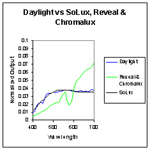
In the past couple of years "daylight" light bulbs have started to be generally sold. These are bulbs which have less yellow light and thus are closer to daylight. The Solux company website persuasively and toughly claims that its competitors all do a bad job of replicating sunlight, as the diagram here shows. If they are being truthful, their own $8 bulb is far better, though it needs a two-prong, non-standard fixture. I wonder whether any normal-fixture bulbs are better than the Reveal brand?

Labels: , ,


To view the post on a separate page, click: at (the permalink).

Tuesday, November 11, 2008


When Does Human Life Begin?

A hard puzzle in abortion policy is when "human life begins". Is a one-celled embryo a human? Is an 8-month fetus a human? Is a 2-year-old a human?

How about if we approach the question from the other end. When does human life end? When is someone dead? It could be when his heart stops, but people do get revived often from that state and we don't call it resurrection. It could be when his brain activity stops, and I think that is the common criterion.

If the criterion for lack of life is lack of brain activity, then the one-celled embryo is not alive. Rather, we need to ask when a brain begins, and when it becomes active. A pro-abortion blog that discusses the brain criterion says that brain activity starts much later than the brain itself is formed, at 21 weeks, which is 5 months. The same blog says anti-abortion people claim the time is 10 weeks (which sounds more plausible to me, and even rather late).

November 18. Another approach would be to ask when an embryo has blood. Blood has special significance in the Bible. This webpage doesn't mention blood specifically, but it implies the embryo has blood somewhere in the 8 to 21 day range. There is a brain at 29-35 days, and brain waves at 40 days. In Arizona, at least, in 2007 of 10,486 abortions, 3,032 were at 6 weeks (42 days) or less. 102 were at 21 weeks or more.

Labels: , ,


To view the post on a separate page, click: at (the permalink).

Saturday, October 25, 2008


Hydrogen Bonds

H. was asking me why ice floats in water-- that is, why solid water is lighter than liquid water. The answer has to do with hydrogen bonds. When hydrogen and oxygen form a molecule together, the hydrogen's lone electron is pulled toward the oxygen, so the other side of the hydrogen has a positive charge from its lone proton. This positive charge is attracted to the negative charge of another oxygen atom's electrons, forming a hydrogen bond. Well, that's my simple story.

The Edinformatics article on ice is good. It has pictures too. It explains that in ice, the hydrogen bonds hold the water molecules apart in a lattice with lots of space, but in water, the molecules do not have such orderly hydrogen bonds.

Here's what Edinformatics's article on hydrogen bonds says:

As the name "hydrogen bond" implies, one part of the bond involves a hydrogen atom. The hydrogen must be attached to a strongly electronegative heteroatom, such as oxygen, nitrogen or fluorine, which is called the hydrogen-bond donor. This electronegative element attracts the electron cloud from around the hydrogen nucleus and, by decentralizing the cloud, leaves the atom with a positive partial charge. Because of the small size of hydrogen relative to other atoms and molecules, the resulting charge, though only partial, nevertheless represents a large charge density. A hydrogen bond results when this strong positive charge density attracts a lone pair of electrons on another heteroatom, which becomes the hydrogen-bond acceptor.
and
In ice, the crystalline lattice is dominated by a regular array of hydrogen bonds which space the water molecules farther apart than they are in liquid water. This accounts for water's decrease in density upon freezing. In other words, the presence of hydrogen bonds enables ice to float, because this spacing causes ice to be less dense than liquid water.
Someone else says:
The hydrogen bonds that form between water molecules account for some of the essential — and unique — properties of water.

* The attraction created by hydrogen bonds keeps water liquid over a wider range of temperature than is found for any other molecule its size.
* The energy required to break multiple hydrogen bonds causes water to have a high heat of vaporization; that is, a large amount of energy is needed to convert liquid water, where the molecules are attracted through their hydrogen bonds, to water vapor, where they are not.

Two outcomes of this:

* The evaporation of sweat, used by many mammals to cool themselves, achieves this by the large amount of heat needed to break the hydrogen bonds between water molecules.
* Moderating temperature shifts in the ecosystem (which is why the climate is more moderate near large bodies of water like the ocean)

Labels:


To view the post on a separate page, click: at (the permalink).

Tuesday, October 21, 2008


Significant Figures

I haven't used this idea since high school, really, but it comes up now and then, so I looked it up in Wikipedia. 100 has one significant figure, as do 20 and 23 and .0001, the article says. The number .00200, however, has three significant figures. The number 1.234 has 4 significant figures. Digits beyond accurate measurement don't count as significant. There is ambiguity, however, in whether 100 feet really has just one significant figure. It may be that you have measured it to the nearest foot, in which case it really has three significant figures.

The real importance of significant figures comes in doing arithmetic. If you run 100 yards in 11.71 seconds, and the 100 has three significant figures, then the speed should be written with three significant figures as 8.54 yards per second, not as 8.53970965 yards per second.

Labels: ,


To view the post on a separate page, click: at (the permalink).