Sunday, December 20, 2009


Aspirin as First Aid for Heart Attacks


I was talking with Pastor Bayly the other day and asked him why he had a pillbox on his keychain. He told me that if you have a heart attack, you should immediately chew up two aspirin. I googled and found that that's true (though it seems one aspirin is probably enough). It makes sense-- aspirin reduces clotting, which is why it bothers some people's stomachs. I saw one comment which pointed out that you should also tell the 911 operator that you took the aspirin, so the ambulance people don't give you more (via a suppository if you are unconscious, say) and you get too much.

Note, too, that if you have aspirin on hand you can help out the improvident heart attacked who neglected to bring theirs. One more reason, till you get round to buying your keychain pillbox, to attend Pastor Bayly's sermons.

Labels: ,


To view the post on a separate page, click: at (the permalink).

Saturday, August 15, 2009


Good Stewardship of Natural Resources

Steve Sailer is right about parks. The Sabbath was made for Man, not Man for the Sabbath.
To get people back to the National Parks, they don't need cheaper admissions (which max out at $23 per vehicle, which is cheap). They need more luxury. For example, in the roadless high country of Yosemite National Park, above Tuolumne Meadows at around 10,000 feet in altitude, there has long been a circuit of about five High Sierra Camps, with tent cabins and dining halls, each a day's walk (6 to 8 miles) apart. So, you can take a five night hiking trip without carrying your own food and fuel, you can sleep in a bed, and have a hot shower (at three camps): it's $136 per person per night for food and lodging. This circuit is very popular with aging nature lovers who don't want to put up anymore with the rigors of sheer wilderness backpacking at high altitude. So you have to apply in a lottery each year in the autumn for the next summer. My aunt and uncle applied every year for about a decade, but never got chosen, and finally gave up when they got too old for high altitude hiking. That's just sad. Considering how popular this amenity is, you might think the National Park Service would have expanded it, adding more High Sierra Camps in Yosemite, and setting up similar circuits in Kings Canyon and Sequoia to the south. In truth, the more remarkable thing is that the NPS hasn't dismantled the High Sierra Camps.

Labels: , ,


To view the post on a separate page, click: at (the permalink).

Friday, August 7, 2009


The American Teenager

Ben Stein in TAS says of director John Hughes (Ferris Bueller's Day Off; Planes, Trains, and Automobiles; Home Alone):

The insight that will make him immortal... was that the modern American white middle class teen combines a Saudi Arabia-sized reservoir of self-obsession and self-pity with a startling gift for exultation and enjoyment of life. No one had ever thought to note that along with James Dean's sulky self-obsession might also come a shriek of happiness at just being alive.

Labels: ,


To view the post on a separate page, click: at (the permalink).

Sunday, July 5, 2009


Saul Alinsky: Rules for Radicals

Saul Alinsky's Rules for Radicals, via a Canadian site: (I have boldfaced the most noteworthy)
Rule 1: Power is not only what you have, but what an opponent thinks you have. If your organization is small, hide your numbers in the dark and raise a din that will make everyone think you have many more people than you do.
Rule 2: Never go outside the experience of your people. The result is confusion, fear, and retreat.
Rule 3: Whenever possible, go outside the experience of an opponent. Here you want to cause confusion, fear, and retreat.
Rule 4: Make opponents live up to their own book of rules. “You can kill them with this, for they can no more obey their own rules than the Christian church can live up to Christianity.”
Rule 5: Ridicule is man’s most potent weapon. It’s hard to counterattack ridicule, and it infuriates the opposition, which then reacts to your advantage.
Rule 6: A good tactic is one your people enjoy. “If your people aren’t having a ball doing it, there is something very wrong with the tactic.”
Rule 7: A tactic that drags on for too long becomes a drag. Commitment may become ritualistic as people turn to other issues.
Rule 8: Keep the pressure on. Use different tactics and actions and use all events of the period for your purpose. “The major premise for tactics is the development of operations that will maintain a constant pressure upon the opposition. It is this that will cause the opposition to react to your advantage.”
Rule 9: The threat is more terrifying than the thing itself. When Alinsky leaked word that large numbers of poor people were going to tie up the washrooms of O’Hare Airport, Chicago city authorities quickly agreed to act on a longstanding commitment to a ghetto organization. They imagined the mayhem as thousands of passengers poured off airplanes to discover every washroom occupied. Then they imagined the international embarrassment and the damage to the city’s reputation.
Rule 10: The price of a successful attack is a constructive alternative. Avoid being trapped by an opponent or an interviewer who says, “Okay, what would you do?”
Rule 11: Pick the target, freeze it, personalize it, polarize it. Don’t try to attack abstract corporations or bureaucracies. Identify a responsible individual. Ignore attempts to shift or spread the blame.

According to Alinsky, the main job of the organizer is to bait an opponent into reacting. “The enemy properly goaded and guided in his reaction will be your major strength.”

Some quotes:

We had to construct experience for our students. Most people do not accumulate a body of experience. Most people go through life undergoing a series of happenings, which pass through their systems undigested. Happenings become experiences when they are digested, when they are reflected on, related to general patterns, and synthesized. (p. 68)

That idea is important. It explains the rate at which people gain wisdom-- or remain as foolish as they were in their youth. People who analyze when young will gain on their non-analytic friends, so we would expect ability and income gaps to rise with age.

Most people have gone to church and mouthed Christian doctrines, and yet this is really not part of their experience because they haven't lived it. Their church experience has been purely a ritualistic decoration... [Of someone who found God and tried giving away his money to bums.] Our friend attempting to emulate Christian life and emulate St. Francis of Assisi found that he could only do so forty minutes before being arrested by a Christian police officer, driven to Bellevue Hospital by a Christian ambulance doctor, and pronounced non compos mentis by a Christian psychiatrist. Christianity is beyond the experience of a Christian-professing-but-not-practicing population. ... I've been asked, for example, why I never talk to a Catholic priest or a Protestant minister or a rabbi in terms of the Judaeo-Christian ethic or the Ten Commandments or the Sermon on the Mount. I never talk in those terms. Instead, I approach them on the basis of their own self-interest, the welfare of their Church, even its physical property.

If I approached them in a moralistic way it would be outside their experience, because Christianity and Judaeo-Christianity are outside of the experience of organized religion. ... The moment I walked out they'd call their secretaries in and say, "If that screwball ever shows up again, tell him I'm out."

Communication for persuasion, as in negotiation, is more than entering the area of another person's experience. It is getting a fix on his main value or goal and holding your course on that target. (p. 89)

This last passage is a devastating criticism of Christianity in America. Alinsky would have applied his rule of making people play by their own rules if he thought it would work. He didn't, with Christian pastors. He doubts they can even conceive of genuine Christianity.

Labels: , , ,


To view the post on a separate page, click: at (the permalink).

Tuesday, June 23, 2009


Does Using Car Air Conditioning Reduce Mileage AT ALL?

Snopes has a good and educational post on car mileage and air conditioning. The air conditioner uses 5 to 30 horsepower, so it might reduce mileage by as much as 20%. On the other hand, driving with your windows down creates drag, which at highway speeds is likely worse for your mileage. The thread also reveals that the gas gauge is driven by manifold intake pressure, rather than direct measurement in the gas tank. The pressure is not all that accurate, apparently, but how inaccurate is not made clear.

Labels:


To view the post on a separate page, click: at (the permalink).

Monday, June 1, 2009


Gadgets and Products To Buy

This page will list products I buy.

  1. Sony Micro Vault Tiny USB

Labels:


To view the post on a separate page, click: at (the permalink).

Monday, May 18, 2009


An Earthquake

I didn't get to see any fires on my trip to California, but I did get to feel a 4.7 magnitude earthquake. My brother and I had our laptops at hand, and there is very good instant info on earthquakes from the government.

Labels:


To view the post on a separate page, click: at (the permalink).

Friday, April 17, 2009


Spring in the Back Yard

Yellow Violets
A Morel
Bluebells

Labels: , , , ,


To view the post on a separate page, click: at (the permalink).

Monday, March 30, 2009


The Amazing Waste from Turning Off Computers Each Night

I saw an article that illustrates why it's good for me to teach students about economic cost as opposed to raw accounting cost:

I leave my laptop running overnight because I know it'll take five minutes or more to get things going in the morning -- not just booting up, but launching the various apps I start the day with, downloading my overnight email, filtering out the spam, and otherwise "getting settled."

But all the power wasted while computers are sitting idle overnight adds up, and one study has finally tried to measure it. The tally: An estimated $2.8 billion wasted on excess energy costs each year in the U.S. alone....

The full report is available for download here (scroll down to "PC Energy Report US 2009")....

If you run a company with 1,000 PCs left on overnight, you can save about $28,000 a year if they are turned off after hours. That's not chump change.

One advantage of the economic way of thinking is that it makes one think of a question here. Why are companies so stupid as to not mandate that their employees turn off computers, if companies could save so much money? The economist naturally wonders if there is something that high-paid corporate executives know that the journalist is missing.

Let's do the full calculation. 1000 PCs * 5 minutes of employee time * 200 days per year * $60/hour or $1/minute = $1 million/year saving from leaving the computer on all night. That compares with $28,000 in energy savings costs.

You can adjust my numbers if you think they're wrong. Suppose its only 1 minute of employee time that it takes them to boot up, 100 days per year that they work, and $6/hour that your company pays them. Then the benefit in labor costs from leaving on the computers is only $100,000 per year, a mere four times the extra cost in electricity.

Labels: , , , , ,


To view the post on a separate page, click: at (the permalink).

Saturday, March 14, 2009


Non-Wrinkle Shirts

From The Right Coast. (I typed in "The Right Cost" at first, by mistake, but a good mistake.)

Labels: , ,


To view the post on a separate page, click: at (the permalink).

Tuesday, January 20, 2009


Reparations for Slavery

Suppose your ancestor was a slaveholder, or a corrupt politician. Ought you to do anything in compensation? What should you do with wealth inherited from that person?

Labels: , , ,


To view the post on a separate page, click: at (the permalink).

Sunday, January 18, 2009


Cold Weather

Peter Hitchens has it right and writes well:

I like sitting round a hearth as much as anybody, or walking into a warm kitchen. But these things are not half so pleasant unless you have come in from the cold outside.

Proper British cold weather is exhilarating, stimulating and good for you. ... I still recall experiencing as a small child the sharper frosts of Scotland, on the Fife coast of the Firth of Forth, and finding the milk solid in the bottles on the doorstep, with the cream thrust up out of the bottle and he foil cap perched on top.

Sometimes it brings glorious clear air, so that you can see further than at any other time of year. Sometimes it comes with mysterious fogs. I am still sad that I shall never see again the overpowering sight of an express steam engine coming into a station one foggy winter dusk in a small Dartmoor town, entirely surrounded by its own cloud of steam glowing pink, red and gold.

When it freezes lakes and ponds, and hardens the earth, it makes sound travel quite differently, so that church bells across a long distance have a special hollow echo to them that (like the bells themselves, only more so) is uniquely English.

Labels: , ,


To view the post on a separate page, click: at (the permalink).

Saturday, January 17, 2009


Uses for WD-40

From Snopes.com: (the donation page for which is here)

The manufacturer-recommended uses for WD-40 spray that remained after their emendations were as follows:
3. Protects silver from tarnishing.
4. Removes road tar and grime from cars.
10. Loosens stubborn zippers.
11. Untangles jewelry chains.
14. Keeps ceramic/terra cotta garden pots from oxidizing.
18. Keeps scissors working smoothly.
19. Lubricates noisy door hinges on vehicles and doors in homes.
21. Lubricates gear shift and mower deck lever for ease of handling on riding mowers.
22. Rids kids rocking chairs and swings of squeaky noises.
23. Lubricates tracks in sticking home windows and makes them easier to open.
24. Spraying an umbrella stem makes it easier to open and close.
26. Restores and cleans roof racks on vehicles.
27. Lubricates and stops squeaks in electric fans.
28. Lubricates wheel sprockets on tricycles, wagons, and bicycles for easy handling.
30. Keeps rust from forming on saws and saw blades, and other tools.
33. Lubricates prosthetic limbs.
34. Keeps pigeons off the balcony (they hate the smell).
35. Removes all traces of duct tape.
37. Florida's favorite use is: "cleans and removes love bugs from grills and bumpers."
43. If you sprayed WD-40 on the distributor cap, it would displace the moisture and allow the car to start.
44. It removes black scuff marks from the kitchen floor! Use WD-40 for those nasty tar and scuff marks on flooring. It doesn't seem to harm the finish and you won't have to scrub nearly as hard to get them off. Just remember to open some windows if you have a lot of marks. Wash off after use.
45. Bug guts will eat away the finish on your car if not removed quickly! Use WD-40!

Labels: ,


To view the post on a separate page, click: at (the permalink).

Thursday, January 8, 2009


Buying Religious Books from Persia

I just received a book I ordered from either an American or a British company (I forget which). It came in an outer wrapper from Dubai, and the inner label is:

New Book Sale
PO BOX: 15875-8573
TEHRAN-IRAN

Is warehouse space really so much cheaper in Iran? Or is it the English-trained handling labor?

And the book? --Philosophy of Religion- Selected Readings.

Labels: , , ,


To view the post on a separate page, click: at (the permalink).

Monday, January 5, 2009


The Charity Gift to an Individual-What Is It?

From Tom Smith at The Right Coast:

Something you can do these days is give someone the gift of having given a gift yourself to some charity. So you might get a card that says, We have given a goat on your behalf to the village of Ubuti in East Ubutistan. As a follow on, you might get a picture of the villagers posing with their new goat, which is from you, sort of.

I'm not saying this is not a nice thing. It is a nice thing. What puzzles me is just what it is. Not from a legal point of view. I'm not aware it raises any legal issues, interesting or otherwise. I just think it's a little baffling what it is. Is it a gift? Somebody says to you, instead of giving you something you don't really want or need, I have elected to give some people something they really do want and need. But then what does that have to do with me? Supposedly, the person sort of forgoing the gift gets the credit for it, but what credit is there, really? I didn't give anybody a gift. Nobody asked me if I wanted to forgo a gift in order to enable the goat giving. I just get a card that says, you just gave a goat to someone, to which I might reasonably respond, I did? Maybe the idea is that the giver thinks I am such a good person I would prefer to have a goat given than to get a gift myself. Well, thanks! If you get a gift of this sort, do you write a thank you note for it?

A commentor noted that the donor, but the not the quasi-recipient, gets the tax break.

Labels: , ,


To view the post on a separate page, click: at (the permalink).

Saturday, January 3, 2009


Enjoying Your Tombstone

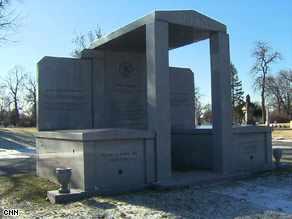
Via Clayton Cramer comes this CNN news story about Mr. Burris's tomb:

Under the seal of the state of Illinois and the words "Trail Blazer," Burris, 71, has listed his many firsts in granite, including being the state's first African-American attorney general and the state's first African-American comptroller.

The memorial also notes that Burris was the first African-American exchange student to Hamburg University in Germany from Southern Illinois University in 1959.

Labels: , ,


To view the post on a separate page, click: at (the permalink).

Friday, January 2, 2009


TV, Intemperance, and Video Games

A comment I made at the Baylyblog on a good entry on the book Goody Two Shoes, family reading, and TV:

Maybe the biggest problem with TV is that you don't get satiated. TV is fine in moderation, like wine and chocolate. If you ingest a lot of wine or chocolate, the desire goes away, at least for that day. Plus, a stomach ache or hangover may remind you that you've sinned. But you can sit in front of the TV indefinitely, and wake up fresh the next day. So the best solution may be to never watch it, just as for some people the best solution to alcohol is never to take a single drop.

I wonder which is a more harmful sin nowadays: insobriety or excessive TV? Or how about excessive video game playing? Heathens may laugh at calling such things sinful, but I'm glad to see pastoral warnings about them. January 3: Clint Mahoney posted the Television poem of Roald Dahl on the Baylyblog. An excerpt:


In almost every house we've been,
We've watched them gaping at the screen.
They loll and slop and lounge about,
And stare until their eyes pop out.
(Last week in someone's place we saw
A dozen eyeballs on the floor.)
They sit and stare and stare and sit
Until they're hypnotised by it,
Until they're absolutely drunk
With all that shocking ghastly junk.

Labels: , ,


To view the post on a separate page, click: at (the permalink).

Sunday, December 28, 2008


Giving Away All One's Possessions

From an old post in He Lives:

I’ve decided (for today, at least) that the toughest verse in the Bible is Luke 12:33. In particular, the first sentence thereof.

32 "Fear not, little flock, for it is your Father’s good pleasure to give you the kingdom. 33 Sell your possessions, and give to the needy. Provide yourselves with moneybags that do not grow old, with a treasure in the heavens that does not fail, where no thief approaches and no moth destroys. 34 For where your treasure is, there will your heart be also. (Luke 12:32-34)

Sell your possessions, and give to the needy. Now, how do I avoid the plain meaning? Let's fire up a couple of tried-and-true escape mechanisms:

1) Is this in a parable? No.

2) Can this be cast as figurative? Does it really mean: "Do not hold on to your possessions. Be willing to give them up at a moment’s notice, should they be of use to God or the church. Do not make idols of your possessions. Do not value your self-made kingdom more then the kingdom of God." Can it be taken that way? No.

A commentor said:

Go back to verse 32 because that is where we are told to whom verse 33 is addressed. It is plainly not Christians living in 2008 AD in Virginia. It is members of His 'little flock' in the year 33 AD or thereabouts living in and around Jerusalem. These are the people concerning whom the Father had already chosen to give them the kingdom. Note that He did not say the Church.

Please don't get me wrong, I am not at all saying that giving to those in need is not a possible application of this verse. Just that the plain meaning has to do with the specific speaker and hearers and the immediate context. Less plain interpretations are what are causing the problem of living up to this plain teaching. By the way, did most of these people have cash to give to others? Or, did they have possessions that had to be liquidated so that the proceeds could be given to others? Note, Jesus does not say sell all your possessions. Could He have meant sell enough so that they could give some funds to others in need? Oh well, it just may not be that plain.

Labels: ,


To view the post on a separate page, click: at (the permalink).

Tuesday, December 23, 2008


Makeup

Megan McCardle educates men on makeup and makeup as a gift in The Atlantic.

Labels:


To view the post on a separate page, click: at (the permalink).

Monday, December 8, 2008


Wide Tires Are Bad on Snow

From Clayton Cramer:

The source of the C5's problems with traction on snow and ice is the combination of rear wheel drive and very, very wide tires. As the tires get wider, the amount of force per square inch declines. There's roughly 700-750 pounds of force per rear tire--and with the standard tires of the Corvette, this spread over an enormously wide piece of rubber. My measurements suggest that the contact patch is about 30-40 square inches--so roughly 19 psi of pressure. At a certain point, the down force is so little that the tires simply have no hope of getting any grip on either snow or ice.

The way that chains work, and studded tires, is by concentrating the roughly 750 pounds of force per tire into a relatively tiny area--perhaps as little as three square inches for chains--so 250 psi, or a square inch for studs (so 750 psi). That's enough to break a hole in the surface of the ice, and allow you to move forward. Ditto for brakes.

Labels:


To view the post on a separate page, click: at (the permalink).